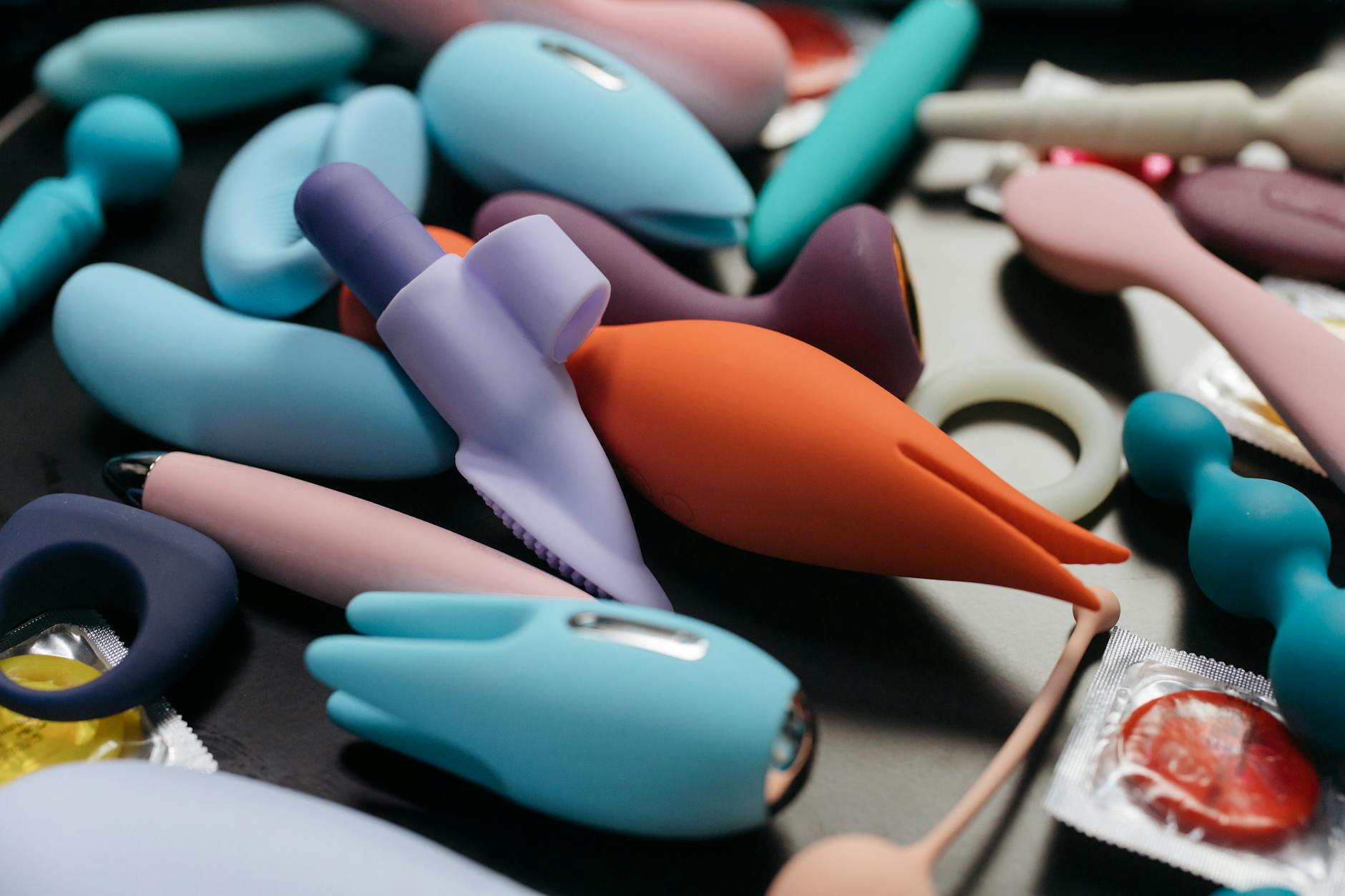
Here's what anxiety does to sex
You're with your partner. Objectively, conditions are perfect. But your brain has already left the room. You're running a mental checklist: "Does this feel good? Should I be making noise? Am I taking too long? What if they're bored? What if I can't come?" The actual sensations—touch, warmth, pleasure—become background noise to the anxiety broadcast running on loop.
That's not a personal failure. That's how the nervous system hijacks pleasure when it's stuck in threat-detection mode. And the more you try to white-knuckle your way back to presence, the more anxious you become. It's a feedback loop that kills desire.
Why lemon vibrators work for anxiety-prone partnered sex
Here's the thing: anxiety thrives in abstraction. Your worried mind loves the future ("What if...") and the past ("Last time..."). It hates the present moment. A lemon clitoral vibrator anchors you to sensation so intensely that your brain has to show up. You can't think about whether you're doing it right when the Lem is humming against your clitoris. You're just... there.
Second, anxiety during sex is often wrapped up in losing control. You're trying to "perform," to meet expectations, to prove you can orgasm. A lemon vibrator is your permission structure. It's saying: "You don't have to do this one thing the old way. You get support." That psychological shift alone can unlock the relaxation needed for pleasure.
Third, clitoral vibrators bypass the performance pressure entirely. When you have a lemon clitoral vibrator, the focus moves away from partnered penetration and toward your own sensation. Your partner isn't waiting for you to come during a specific window. You're both collaborating on your pleasure, which changes the whole emotional tone.
The setup: talking to your partner first
Don't introduce a lemon vibrator mid-encounter and hope it lands well. Talk about it beforehand. Seriously. A conversation like this works: "I've noticed I get anxious during sex, and it pulls me out of the moment. I'm wondering about using a vibrator during partner time. Not instead of you, but alongside. Something that helps me stay present." Most partners hear this as: "I want to enjoy this more. I want to be here with you."
If your partner resists, that's real information. Listen to it. Sometimes the resistance is about insecurity ("Does this mean I'm not enough?"), which is workable through reassurance and communication. Sometimes it's about different comfort levels with toys, which is a boundary to respect. Pushing isn't the move.
If you get a green light, decide together: Will they hold the vibrator? Will you? Will they focus on a different part of your body while you use it? These details matter because they determine how grounded you feel.
The technique: using the Lem when anxiety shows up
Start before the anxiety does. Don't wait until your nervous system has already escalated. Turn on the vibrator—or have your partner turn it on—at a low intensity (settings 1–3 on the Lem) early in foreplay, when you're still in your body.
Here's the key: don't think about the orgasm goal. The point of using a lemon vibrator with anxiety isn't to "make sure you come." It's to make sure you stay present. If orgasm happens, great. If it doesn't, you've still won because you were actually there.
When your mind starts drifting (and it will), bring it back to sensation. "What does this feel like right now?" Not "Am I feeling enough?" or "Is this working?" Just pure description. Warm. Buzzing. Rhythmic. The texture of wherever the vibrator is touching.
If anxiety spikes—you notice your breathing getting shallow, your body getting tense—pause. Tell your partner. Try this: pause the vibration for 10 seconds, breathe together, and then restart at a lower intensity. Anxiety often needs permission to exist before it'll back off. Fighting it just digs the hole deeper.
Why intensity matters when you're anxious
Countintuitive thing: lower intensity helps anxious people more than higher intensity. Higher intensity can sometimes push an already-activated nervous system further into stress. The Lem's versatility here is massive. You're not locked into one sensation.
Start at 1 or 2. Stay there until your mind stops spinning and your body softens. Only move up if you want to, not because you feel like you should. Your partner might notice: "You're more relaxed at this setting." That's the information. That's the wisdom.
The role of your partner during this
Your partner's job isn't to perform. It's to be present. If they're inside you while you're using the vibrator, they can slow down, check in, move with you instead of at you. If they're outside your body, they can touch other parts of you—your face, your ribs, your thighs—so you're receiving pleasure from multiple directions. That makes anxiety harder to sustain.
Some anxious people also benefit from eye contact or verbal reassurance. "You're doing great. I'm right here. Just feel this." Others find too much attention suffocating. What matters is honest communication about what your nervous system actually needs, not what you think you should need.
When to use the vibrator as a solo reset
Sometimes the anxiety shows up the night before. You're already bracing. Using the lemon vibrator alone—on your own terms, at your own pace—can actually reset your nervous system enough that the next day's partnered encounter goes differently.
There's research showing that self-pleasure, especially with a tool that creates strong sensation, helps regulate the nervous system. You're teaching your body: "Sex can feel good. You're safe here. Your pleasure matters." That groundwork makes it easier to stay present when your partner is involved.
Red flags and when to get support
If anxiety during sex is severe—you're having panic attacks, dissociating, or it's tanking your relationship—a vibrator is a helpful tool, not a replacement for therapy. A therapist trained in cognitive-behavioral therapy or somatic approaches can actually rewire the nervous system response, not just band-aid it.
Similarly, if anxiety is paired with trauma history, go slow. A lemon vibrator can be grounding for trauma survivors, but it can also be triggering if you're not ready. There's no timeline. Work at the pace that feels safe.
The permission you're actually giving yourself
When you introduce a lemon clitoral vibrator into partnered sex, you're not admitting failure. You're admitting that your nervous system works a certain way and you're willing to design around it instead of fighting it. That's actually the opposite of failure. That's self-knowledge translated into action.
Anxiety is real. Pleasure is real. The two can coexist if you stop trying to white-knuckle through one to get to the other. A vibrator is just the tool. The real shift is giving yourself permission to show up differently.